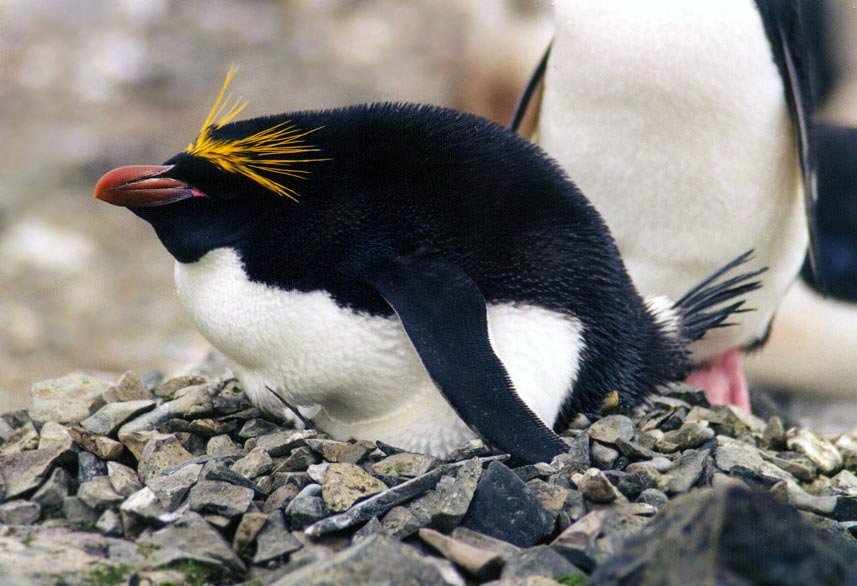
If you're ever angry or annoyed, vexed, enraged or frustrated, simply look at a penguin.
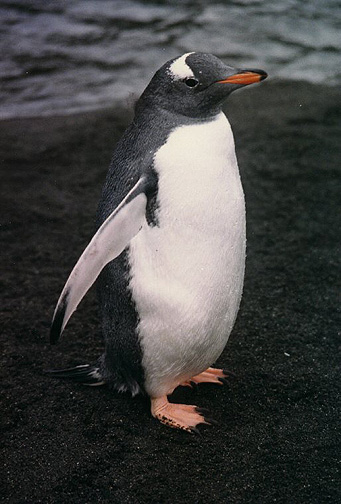
Marvel at the absurdity of such a creature. Bask in the ridiculousness of those tiny legs, the big, flappy wings and the beady little eyes that betray a beautiful, almost child-like naivety. You cannot imagine a penguin ever being malicious or cruel. Cheeky and naughty maybe, but never mean.
Look at him, just chilling out. He doesn't have a care in the world, and neither should you. Life is far too short to waste it on worries, anger and uncertainty, so just chill out and roll with it. He gets it, and so does the next one.
He's so cool, so utterly unconcerned with anything. He'll just stand there all day, head cocked to one side in a pose that would take fashion models years to perfect. Isn't he beautiful?
This penguin will kick your ass without even moving. He's just that awesome. You wanna fight him? You wanna be angry and aggressive and waste your life being mad at things you can't control? Look into his eyes. He understands, and he empathizes with you; but he has no time for your silliness, he's too busy just being an awesome penguin.
Wednesday, 14 September 2011
Tuesday, 13 September 2011
Maps
In my previous post on peanut butter, I mentioned that I love old maps, but this isn't quite true.
I love all maps.
Cartography (from the Greek chartis = map and graphein = write) is a wonderful art, a method of viewing the world that combines both skill, passion, attention to detail and dedication. To relay information about reality in a format that is easy to understand, portable and accurate has long been a goal of explorers and civilizations all over the world, and maps are the ideal way of conveying such data.
I think the adoption of ships as the main form of transporting huge amounts of goods from the New World back to the central powers in Europe was probably the largest catalyst for cartographers. Maps and charts were vital in order to give the trip the best chance of survival; sure, you might still die on the voyage of scurvy, pirates or unfriendly locals, but at least your chances of getting lost, and therefore journey times, were drastically reduced - and the less time you spent at sea, the faster you could make money from your goods and the less chance you had of dying.
It is thought the very first maps date from 8,000 years ago, and they have grown in complexity and beauty ever since.
If you look at the image of the map from 1852 above, you'll see the legend 'On Mercator's Projection'. This means the map uses Mercator's cylindrical projection system in order to display the Earth in a simple way that is most useful to sailors who need the charts for navigation. A set of complicated equations is needed to alter the position of objects such as continents from a spherical surface onto a uniform cylinder. This leads to some distortion, which becomes more and more exaggerated as you head towards the poles.
Mercator's Projection is the one we are most familiar with; however, distortion has led to the effect that Greenland is the size of Africa, whereas Africa is in fact 14 times the size of Greenland. Alaska appears roughly the same size as Brazil, but the latter is actually 5 times larger than Alaska. However, for something devised in 1569, it's not a bad attempt.
Since then, dozens of people have attempted to combine mathematics and common sense into producing a suitable, accurate map that displays the Earth, which is curved, on a flat surface. A list of them can be found here. My personal favourite has to be the Polar Azimuthal Equidistant Projection, mainly because it is such a great way to view the world: we are all spread out evenly, with no one continent given preference over any other. You may have seen it before, on the emblem of the United Nations:
Maps are not just required on a global scale.
We need them to get around our cities and countries, to find suitable routes to work or the fastest way to get to your holiday destination. Since the advent of aeroplanes, large maps for mass travel and transportation between continents have become less crucial, but cartographers are still able to busy themselves with producing the most accurate and detailed local maps they can.
What started thousands of years ago with carvings on walls and tablets has culminated in projects like Google Earth and Bing Maps, as well as Sat-Nav and GPS, arguably the some of the most useful tools ever created.
But what next? Now that we have satellites and aircraft equipped with cameras that can map the world for us, where do we go from here?
Easy: Space. There are hundreds of bodies out there that need mapping for us to better understand them, just as creating a map of our world helped us to know it better; and when that is done, you can always fall back on fantasy, simply creating maps and charts of imaginary worlds for the fun of it. I do this quite often - a doodle can turn into an entire planet with continents, countries, cities, rivers, seas and islands, all waiting to be explored and described in my head...
I love all maps.
Cartography (from the Greek chartis = map and graphein = write) is a wonderful art, a method of viewing the world that combines both skill, passion, attention to detail and dedication. To relay information about reality in a format that is easy to understand, portable and accurate has long been a goal of explorers and civilizations all over the world, and maps are the ideal way of conveying such data.
![]() |
| Map of the world centered on America prepared by the American atlas publisher Joseph Hutchins Colton in 1852 |
It is thought the very first maps date from 8,000 years ago, and they have grown in complexity and beauty ever since.
If you look at the image of the map from 1852 above, you'll see the legend 'On Mercator's Projection'. This means the map uses Mercator's cylindrical projection system in order to display the Earth in a simple way that is most useful to sailors who need the charts for navigation. A set of complicated equations is needed to alter the position of objects such as continents from a spherical surface onto a uniform cylinder. This leads to some distortion, which becomes more and more exaggerated as you head towards the poles.
Mercator's Projection is the one we are most familiar with; however, distortion has led to the effect that Greenland is the size of Africa, whereas Africa is in fact 14 times the size of Greenland. Alaska appears roughly the same size as Brazil, but the latter is actually 5 times larger than Alaska. However, for something devised in 1569, it's not a bad attempt.
Since then, dozens of people have attempted to combine mathematics and common sense into producing a suitable, accurate map that displays the Earth, which is curved, on a flat surface. A list of them can be found here. My personal favourite has to be the Polar Azimuthal Equidistant Projection, mainly because it is such a great way to view the world: we are all spread out evenly, with no one continent given preference over any other. You may have seen it before, on the emblem of the United Nations:
Maps are not just required on a global scale.
We need them to get around our cities and countries, to find suitable routes to work or the fastest way to get to your holiday destination. Since the advent of aeroplanes, large maps for mass travel and transportation between continents have become less crucial, but cartographers are still able to busy themselves with producing the most accurate and detailed local maps they can.
What started thousands of years ago with carvings on walls and tablets has culminated in projects like Google Earth and Bing Maps, as well as Sat-Nav and GPS, arguably the some of the most useful tools ever created.
But what next? Now that we have satellites and aircraft equipped with cameras that can map the world for us, where do we go from here?
Easy: Space. There are hundreds of bodies out there that need mapping for us to better understand them, just as creating a map of our world helped us to know it better; and when that is done, you can always fall back on fantasy, simply creating maps and charts of imaginary worlds for the fun of it. I do this quite often - a doodle can turn into an entire planet with continents, countries, cities, rivers, seas and islands, all waiting to be explored and described in my head...
Friday, 9 September 2011
Peanutter
'Peanutter' is the word I used to use until my early teens when talking about Peanut butter. Apparently, two words was simply too much to bother with, but I am happy to say that I have grown out of that habit; however, I have not grown out of loving the sweet, nutty paste that is the source of so much joy and wonder around the world.
Peanut butter is possibly my favourite thing in the world, right up there with chocolate, the space shuttles and old maps.
As the name suggests, it is a buttery paste made from crushed peanuts, the origins of which date back to the Aztec Native Americans centuries ago. It wasn't until the late 1800's that modern processing methods and the addition of vegetable oil made it a smooth, spreadable foodstuff, and several patents from that period exist for different methods of peanut butter production.
Today, peanut butter is popular in North America, the UK, the Netherlands and parts of Asia, with the world's biggest exporters being the U.S.A. and China. It is available in two forms: Smooth and Crunchy. I find myself quite firmly planted in the 'Smooth' camp - Crunchy is yummy enough, but the bits get stuck in my teeth and it's just slightly more annoying to deal with in general.
The U.S. actually has a law about Peanut butter that determines exactly what it is and what may or may not be put into it. Read it here (if you like that kind of thing).
I actually eat the stuff pretty much everyday, on toast or in a sandwich, and I never, ever get bored of it. My favourite brand of Peanut butter is definitely Skippy, but that stuff is hard to find over here (luckily, because it is really quite bad for you...)
The healthiness of Peanut Butter depends entirely upon the type of oil used in the manufacturing process; avoid those that make use of hydrogenated vegetable oils, that are rich in trans fatty acids. Naturally, peanuts contain protein, vitamins B3 and E, magnesium, folate, dietary fiber, arginine, and high levels of the antioxidant p-coumaric acid, and this good stuff is passed on in peanut butter, making it really quite a useful addition to the diet.
The peanut plant is susceptible to the mold Aspergillus flavus which produces a nasty carcinogenic substance called aflatoxin. Since it is impossible to completely remove every instance of aflatoxins, contamination of peanuts and peanut butter is monitored in many countries to ensure the levels of this carcinogen remain safe for human consumption.
January 24th is National Peanut Butter Day in the United States, and I think the entire world should have a holiday to celebrate this fabulous stuff, where we can bathe in it, throw it at each other in the streets and where we are forced to spread it over everything we eat. Peanut butter and chicken salad, anyone?
Peanut butter is possibly my favourite thing in the world, right up there with chocolate, the space shuttles and old maps.
As the name suggests, it is a buttery paste made from crushed peanuts, the origins of which date back to the Aztec Native Americans centuries ago. It wasn't until the late 1800's that modern processing methods and the addition of vegetable oil made it a smooth, spreadable foodstuff, and several patents from that period exist for different methods of peanut butter production.
Today, peanut butter is popular in North America, the UK, the Netherlands and parts of Asia, with the world's biggest exporters being the U.S.A. and China. It is available in two forms: Smooth and Crunchy. I find myself quite firmly planted in the 'Smooth' camp - Crunchy is yummy enough, but the bits get stuck in my teeth and it's just slightly more annoying to deal with in general.
The U.S. actually has a law about Peanut butter that determines exactly what it is and what may or may not be put into it. Read it here (if you like that kind of thing).
I actually eat the stuff pretty much everyday, on toast or in a sandwich, and I never, ever get bored of it. My favourite brand of Peanut butter is definitely Skippy, but that stuff is hard to find over here (luckily, because it is really quite bad for you...)
| When I was a kid, seeing this tub in the shopping bag was like Christmas had come early |
The peanut plant is susceptible to the mold Aspergillus flavus which produces a nasty carcinogenic substance called aflatoxin. Since it is impossible to completely remove every instance of aflatoxins, contamination of peanuts and peanut butter is monitored in many countries to ensure the levels of this carcinogen remain safe for human consumption.
January 24th is National Peanut Butter Day in the United States, and I think the entire world should have a holiday to celebrate this fabulous stuff, where we can bathe in it, throw it at each other in the streets and where we are forced to spread it over everything we eat. Peanut butter and chicken salad, anyone?
Thursday, 8 September 2011
'Vader' is Dutch for 'Father'
It should have been so obvious.
Also, I can't be the only guy out there who thinks a zombie/Star Wars crossover is the most fantastic idea since... well, since the wheel?
Tuesday, 6 September 2011
The Pale Blue Dot
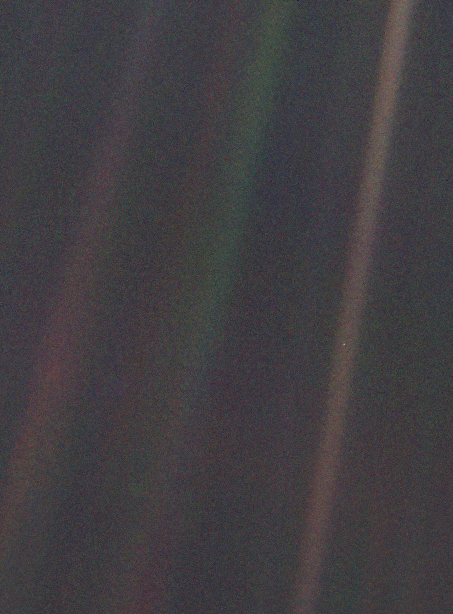
"Consider again that dot. That's here. That's home. That's us. On it everyone you love, everyone you know, everyone you ever heard of, every human being who ever was, lived out their lives. The aggregate of our joy and suffering, thousands of confident religions, ideologies, and economic doctrines, every hunter and forager, every hero and coward, every creator and destroyer of civilization, every king and peasant, every young couple in love, every mother and father, hopeful child, inventor and explorer, every teacher of morals, every corrupt politician, every "superstar", every "supreme leader", every saint and sinner in the history of our species lived there - on a mote of dust suspended in a sunbeam.
The Earth is a very small stage in a vast cosmic arena. Think of the rivers of blood spilled by all those generals and emperors so that, in glory and triumph, they could become the momentary masters of a fraction of a dot. Think of the endless cruelties visited by the inhabitants of one corner of this pixel on the scarcely distinguishable inhabitants of some other corner, how frequent their misunderstandings, how eager they are to kill one another, how fervent their hatreds.
Our posturings, our imagined self-importance, the delusion that we have some privileged position in the Universe, are challenged by this point of pale light. Our planet is a lonely speck in the great enveloping cosmic dark. In our obscurity, in all this vastness, there is no hint that help will come from elsewhere to save us from ourselves.
The Earth is the only world known so far to harbor life. There is nowhere else, at least in the near future, to which our species could migrate. Visit, yes. Settle, not yet. Like it or not, for the moment the Earth is where we make our stand.
It has been said that astronomy is a humbling and character-building experience. There is perhaps no better demonstration of the folly of human conceits than this distant image of our tiny world. To me, it underscores our responsibility to deal more kindly with one another, and to preserve and cherish the pale blue dot, the only home we've ever known...
... Stare at the dot for any length of time and then try to convince yourself that God created the whole Universe for one of the 10 million or so species of life that inhabit that speck of dust. Now take it a step further: Imagine that everything was made just for a single shade of that species, or gender, or ethnic or religious subdivision. If this doesn't strike you as unlikely, pick another dot. Imagine it to be inhabited by a different form of intelligent life. They, too, cherish the notion of a God who has created everything for their benefit. How seriously do you take their claim?"
Carl Sagan, 1994
Carl Sagan is one of my heroes, mainly because of these passages from his book Pale Blue Dot: A Vision of the Human Future in Space. The image he refers to was taken by the Voyager 1 spacecraft in 1990 at a distance of about 6 billion kilometres from Earth, just as it was leaving the Solar System. It was Sagan who requested the image to be taken, and it remains a fabulous reminder of the utter insignificance and fragility of our world and its inhabitants - something I feel it would be very beneficial for everyone to remind themselves of once in a while.
Friday, 2 September 2011
The Apennine Colossus
I saw this picture randomly the other day and I was utterly awe-struck. For a start, the doorway below is about the height of a person, and it has three floors of rooms inside. Imagine conceiving and sculpting something this huge. What an epic task.
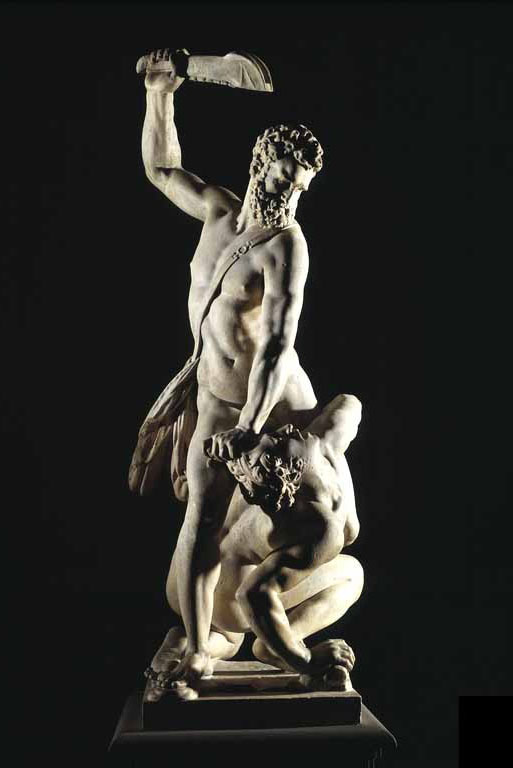
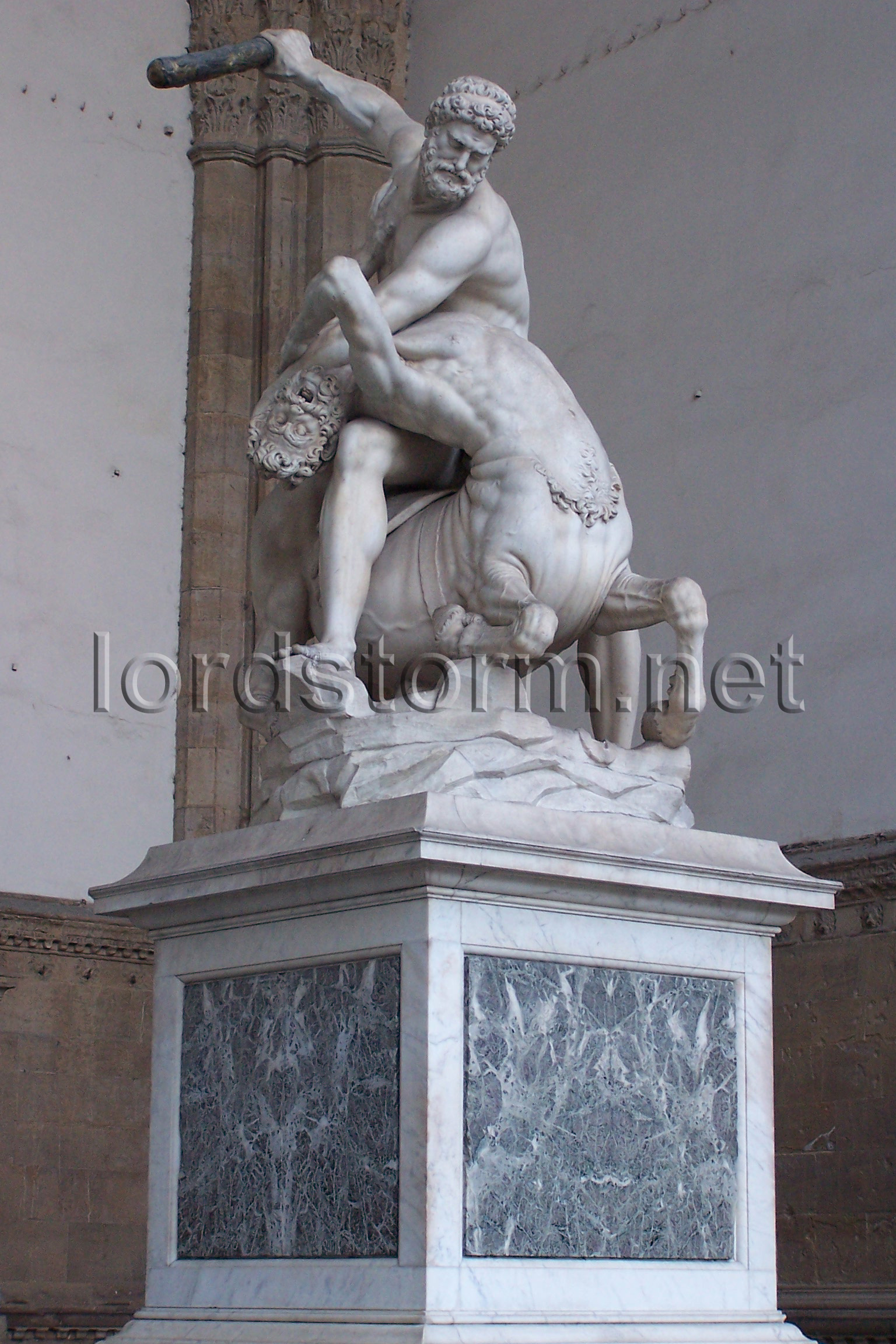
This beautiful work of art is situated in the gardens of what was once the Villa di Pratolino, a Renaissance patrician villa in Vaglia, Tuscany, Italy. The villa and gardens were constructed between 1569 and 1581, and the Colossus came into being between 1579 and 1580. The villa itself was mostly demolished in 1820, but the gardens survived and are still open to the public today. The Apennine Colossus, or Appennino, was created by legendary Italian sculptor Giambologna (1529 - 1608), who is responsible for well-known works such as various versions of Mercury, plus Samson Slaying a Philistine (1562), Rape of the Sabine Women (1574-82) and Hercules beating the Centaur Nessus (1599).
His first major commission was given him by the nephew of Pope Pius IV, which was to create the bronze figures of Neptune and the others on the Fountain of Neptune in Bologna, which was finished in about 1567. On that fountain, I particularly like the lactating figures around the bottom. Those renaissance types sure knew how to add a touch of class to their town squares.
Thursday, 1 September 2011
The Museum
Yesterday, I visited the National Museum of Scotland here in Edinburgh. What a fantastic place!
It's free to get in, and is absolutely stuffed with cool things to gawk at.
Some of the items there include:
Ancient Egyptian writing tablets
Blue Whale jaw bones
A Black Knight rocket
Native American tribal dress
A ski-doo
A skeleton cast of a Giant Sloth
A huge 1950's telescope from the Royal Observatory
Stunning geode formations
At least one set of bagpipes
It really is a brilliant collection, the museum itself is beautiful, having just undergone extensive renovation. One of the most fascinating exhibits, to me anyway, was Sir Alexander Fleming's impressive collection of awards and medals, particularly his 1945 Nobel Prize for Medicine. It was the first time I have ever seen a Nobel medal in the flesh, and it was an awe-inspiring moment to gaze upon objects that once belonged to such a brilliant and important person - it has been estimated that his discovery of penicillin has helped save over 200 million lives in the last 50 or so years.
You can search and browse the Museum's collections in a surprisingly well-made and easy to use catalogue here: http://www.nms.ac.uk/collections/
I have absolutely no doubt that we'll be going back again soon - even a few hours there was not enough to see everything - and maybe next time I will remember to take the camera with me...
Subscribe to:
Posts (Atom)