Thursday, 13 October 2011

Graffiti

Something that has always fascinated me is graffiti. I'm not talking about scrawling your name over a wall with a fat pen, I'm talking proper, artistic, beautiful masterpieces.

As I grew up, I found the drab greyness of suburban life rather a drag; the average building around where I lived (Uxbridge and Hillingdon, North-West London) was decidedly dreary in comparison to the beauty of the natural world. There were parks, sure, but they were boring, built not for attractiveness but for functionality: all children's play areas and football pitches. The urban environment lacked imagination, sparkle and colour.

I started to notice graffiti at quite a young age and immediately found it interesting. Why would someone go to the time of spraying such elaborate designs on a public wall? Why would they risk getting caught by the police for the sake of painting? The rebelliousness really struck a chord with me. I will be the first to admit, I was a  good kid. Maybe too good. I never did anything wrong, and part of me regrets that these days - to have been out there exploring and messing about must have been exciting.

My younger brother used to go out tagging at night, he would take a thick yellow or black paint pen and doodle his name or a signature 'tag' on some wall somewhere. He'd spend hours practicing on sheets of A4 paper, wasting hundreds of them, and it boggled my mind, how someone could be out there doing this stuff and not want to actually create something beautiful. At that moment, I realised I understood proper graffiti - it is art. Tagging is just destroying property, it's ugly and pointless, whereas someone who can put even a moment's thought into an original and quality design before spraying can be regarded as an artist who wants to brighten up the bleary, grey urban landscape.

For my birthday this year, my partner bought me a book called Graffiti World by Nicholas Ganz. If you've ever had more than a passing interest in graffiti, I highly recommend it as a rather detailed and thorough guide to street art all over the world. Reading interviews in the book with these artists has helped confirm my belief that ultimately, graffiti is a good thing. It not only pretties up the place, but it can also be used to convey important political or ideological messages, or simply provide a moment of insight and inspiration.

My favourite pieces are usually very simple messages that contain a great truth or idea in very few words.


My other favourite type of graffiti are those that combine epic characters and abstract murals and paintings.

Seak

Faith 47

rockGroup

Daim

Corail
Maybe someday I will try to develop and perfect my own writing style, but I am very unlikely to ever use it out on the street. Luckily, I am quite happy to bask in the magnificence of these writers and their art without going out and practising it for myself.

Monday, 10 October 2011

The Aral Sea

If I asked you to point to the Aral Sea on a map, you might guess somewhere in central Asia, you know, one of those places like the Dead Sea or the Black Sea that sounds vaguely exotic and mysterious. It was, in fact, on the border between Kazakhstan and Uzbekistan, not far to the East of the Caspian Sea.

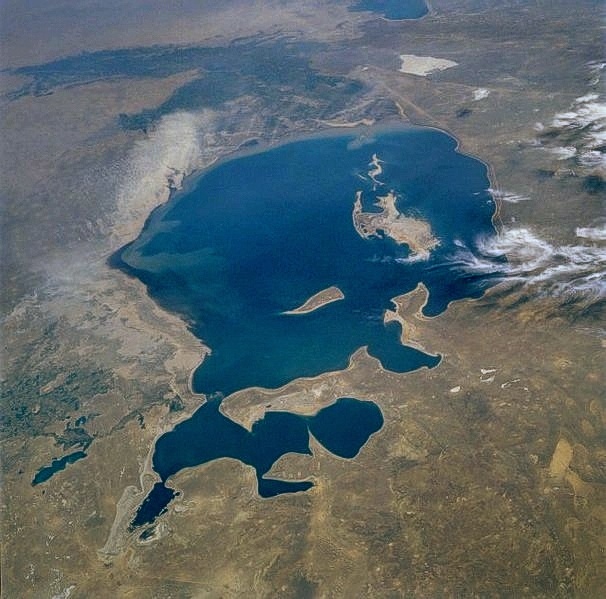
I say 'was', because it has shrunk at a horribly alarming rate. In 1985, the Aral Sea was the fourth largest lake in the world, covering approximately 26,000 square miles. This is a view of it from the north side, taken by a Space Shuttle.


Over the next couple of decades, the sea began to shrink quickly, due to irrigation works carried out in the 1960's by the Soviet Union. The canals they built diverted water away from the two main rivers that fed the Aral Sea, to cotton farms in the surrounding areas. Soviet Engineers predicted that this would cause the lake to dry up, but the projects went ahead anyway, without regard for the impact on the environment and people that lived around the Aral Sea.


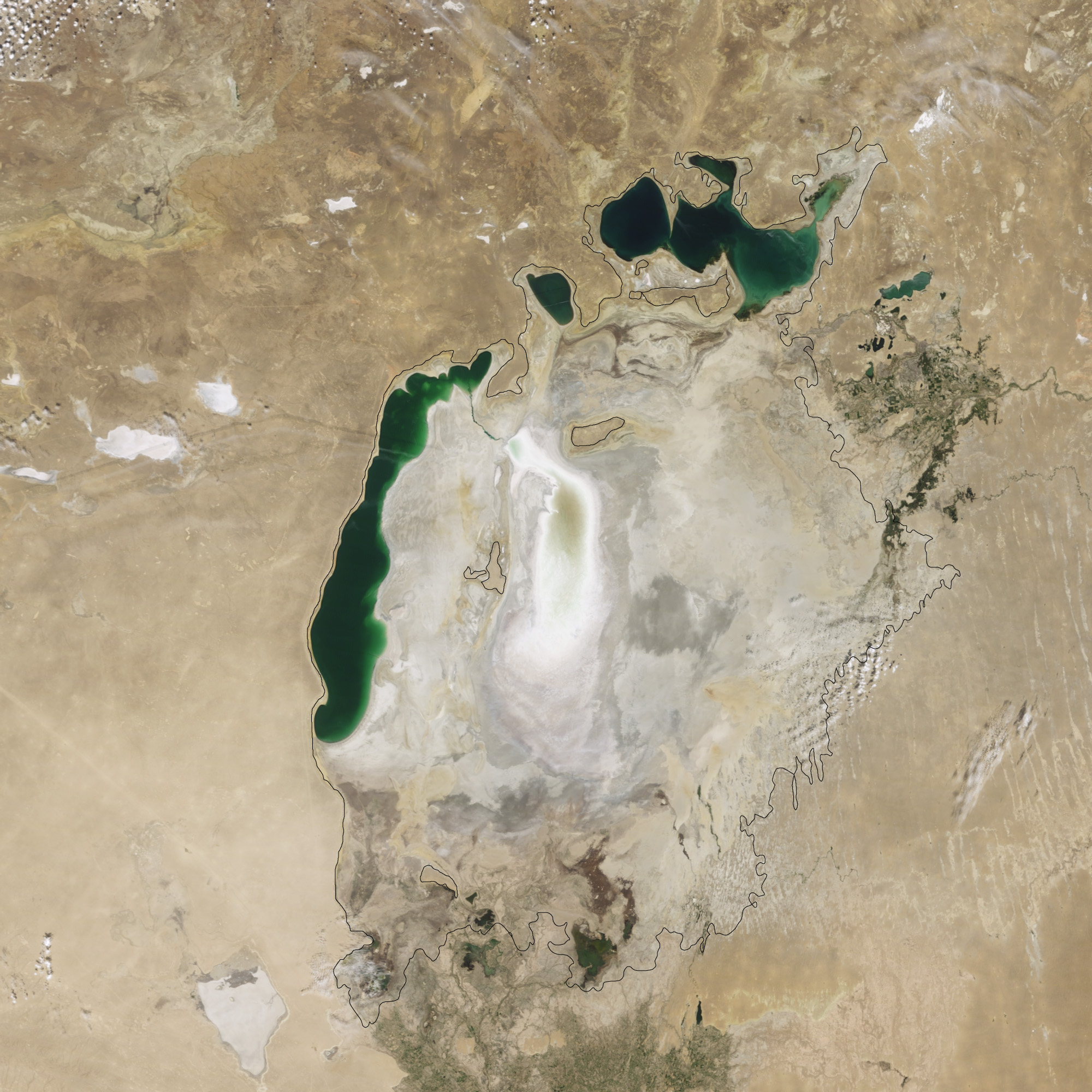
August, 2009. The Aral Sea is now only the world's eighth largest lake, and is split into two portions that cover barely ten percent of its original surface area. The Little Aral Sea is the blob at the top (north) of the image, located within Kazakhstan. A dam has been constructed to hold the water in, and to slow evaporation. Water levels are now rising in this smaller portion of the Sea, enough to reduce salinity and allow fish stocks to recover. However, the southern Aral Sea, located in much poorer Uzbekistan, has no such project, and with no major source of water flowing into it, is likely to have vanished entirely by 2020.

This is not some small puddle. The amount of water lost from the Aral Sea is equivalent to completely draining Lake Erie and Lake Ontario, the two smallest of North America's five Great Lakes, some 900+ cubic kilometres of water. The fishing industry on the Aral Sea once employed 40,000 people and is now utterly destroyed. The main fishing town is now miles from any water, and the few fish that do remain have to compete with increasing salinity - more than 20 species of flora and fauna have become extinct. Boats litter the desert that was once the sea bed, a desert that is poisoned by chemicals and toxins from farming cotton, and from the Soviet chemical and biological weapons testing facility on Vozrozhdeniya or "Rebirth Island" (which is now no longer an island and is merely part of the exposed lake bed). Dust storms whip up the toxic sand and blast it across the basin, causing serious health problems for those who still live in the surrounding areas.

All in all, the Aral Sea is a tragic example of a government putting short term financial ideals ahead of long term environmental and human needs. Work is underway to try to save the Aral Sea but most projects are prohibitively expensive and totally impractical. It is very likely that the only remains of this once vast body of water will be a small lake and a poisoned, lifeless desert.

Thursday, 6 October 2011

Quotes

Today, I'd like to share some of my favourite inspiring quotes with you. The thing about a good quote is that it has to be succinct, direct, and ultimately strike you as the truth. In everything from speeches to song lyrics, there are lines and phrases that grab hold of me and drag me to another place - often one of clarity and inspiration, but sometimes quite the opposite. I'll try to explain why I love each quote as we go along.

"Imagination is more important than knowledge" 

- Albert Einstein

I often list Einstein among my favourite people of all time, and for good reason. Not only was he quite possibly the greatest physicist of the 20th century, but he was also a campaigner for human rights, equality and education. You need only look at his Wikipedia page to see just how much he contributed to the world of science. His most famous work is surely the E=mc^2 equation, which states that the mass of a body is a measure of its energy content. I do feel that imagination is more important than knowledge, but it took this quote to help me realise it - you can know everything in the world, but without imagination, you can't dream of what to do with that knowledge.

"Our lives begin to end the day we become silent about things that matter" 

- Martin Luther King, Jr.

I've always held the ideals of equality close to my heart, and MLK is possibly the finest example of a modern human rights leader as you're likely to find. His speeches were utterly intoxicating, and I could give you several fantastic quotes from him that have inspired me in the past. I think his assassination was ultimately, not such a bad thing; he became such a powerful symbol in death, more so than he ever could have in life.

"A conservative is a man who believes nothing should be done for the first time"

- Alfred E. Wiggam

I am strongly opposed to conservatism in all of its forms, and this quote beautifully sums up my feelings about those who wish to 'conserve' whatever ideal they promote - whether it is a return to an older system or way of life or maintaining things as they are and opposing progress on principle. The state of the world now and in the past is a shocking, horrible mess, unfair and unjust - to keep it the same or send it backwards, is, in my view, to remove basic freedoms and securities that people need in order to survive. Progress is a positive thing, always - to work towards a goal, to improve and grow, is surely the natural desire of all living things - to conserve and regress is to stunt, limit and wither.

"To laugh often and much; to win respect of intelligent people and the affection of children... to leave the world a better place... to know even one life has breathed easier because you have lived. This is to have succeeded."

- Ralph Waldo Emerson

This quote pretty much sums up my entire philosophy on life. Success cannot be measured by how much money you earn or how many fans you acquire, but by the positive impact you have made on other people's lives - to be remembered fondly is the greatest achievement that I can imagine.

"Whatever you do will be insignificant, but it is very important that you do it."


"You must be the change you want to see in the world."


"When I despair, I remember that all through history the ways of truth and love have always won. There have been tyrants, and murderers, and for a time they can seem invincible, but in the end they always fall. Think of it--always."

- Mahatma Gandhi

Three epic quotes from one epic person. They speak of personal responsibility, the reality of an individual's limited effect on the world, but the huge effect he will have on those around him, the dangers of hypocrisy and the hopeful, beautiful idea that all bad things come to an end.

"Remembering that you are going to die is the best way I know to avoid the trap of thinking you have something to lose. You are already naked. There is no reason not to follow your heart."

- Steve Jobs

Say what you like about his company, Apple, but Jobs himself was a rather brilliant man, and I know he will be missed.

Wednesday, 28 September 2011

Dinosaurs!

We went to see Jurassic Park at the cinema last night. It's out on re-release for some reason, maybe because the film is now almost twenty years old - which is a scary thought - perspective like that really helps you appreciate just how old you are getting.

I must confess that Jurassic Park is probably my favourite movie of all time. Watching it again yesterday allowed me, for the first time, to properly appreciate the brilliance of it; rather than just going "OOOH DINOSAURS RAWR!", I was able to consider just how much creative effort must have gone into building the models and rendering the CGI of the monsters in the movie. I've seen films released in the past couple of years that have worse effects than Jurassic Park. Since this one, there have been a couple of sequels of declining quality - none of them come close to the visceral impact of the original.

The acting is brilliant too, especially from the two children, Lex and Tim - the way they portray fear and excitement is utterly and entirely believable, dragging you deeper into the world of the movie. Tim reminds me of myself at his age, actually: inquisitive, excitable, slightly awkward and goofy but eager to learn and explore.

But what makes me love this movie, and dinosaurs, so much?

Honestly, I have no idea.

I've always loved dinosaurs. They were a defining feature of my childhood, thanks partly to Jurassic Park, but also due to multiple trips to the highly impressive Natural History and Science Museums in London. The idea of a world filled with these giant monsters is utterly fascinating and bewitching.

When I say giant monsters, I mean it:


I do genuinely wish that some species had survived until today, imagine going on safari and seeing a Triceratops! Of course, they were pretty much all wiped out 65 million years ago, and the survivors eventually evolved into what we know today as birds.

Rawr!
More and more dinosaurs have been found in the past few years that exhibit evidence of having primitive feathers on their bodies, sometimes as a fluffy coat, others had them for dominance displays and gliding.


The Microraptor
Of course, everything that we know about dinosaurs has to be guessed at from fossil records or figured out by examining birds today, but that just makes them all the more intriguing and exotic. I think part of their charm is that we've had to build up our knowledge of them from scratch, and in doing so, they have become partly our own creations - ripe for use in all kinds of media, stories and childhood fantasy adventures.

Monday, 26 September 2011

The Third Sphere

Perhaps this blog has become a little too focused on art and science, I need to randomise it up a bit... but what other fields are there? Almost everything that interests me can either be broadly defined as art or science. Music, photography, sculpture and literature can be lumped together as the former, whereas astronomy, engineering, animals and nature, history and geography can be loosely associated with science, or at least, the study of those fields involves some degree of scientific approach.

Some things can be thrown onto the border between both definitions: architecture, cartography and even gadgets/electronics combine significant elements of each.

Perhaps only a few things fall outside of these two spheres.

One of these is religion and the spiritual world.

I guess you could say that science, art and spiritualism occupy the three most commonly referred to body parts; science is the brain, art is the heart, and religion has the soul. It's a neat way of looking at it, I think.

I am by nature a skeptic: I like proof and evidence.

This leads me, inexorably, to being an atheist.

I do not believe in a God, a Heaven or a Hell. There is no Devil. No sin. No spiritual afterlife.

There is a reason why no prayer has ever been answered; why there has never been any actual evidence of any kind of divine intervention; and why no miracles have ever been documented that could not be explained through scientific examination.

I personally feel that religion was invented as a way of explaining the world at a time when science was in it's infancy. It has done some good over the centuries, teaching morals and keeping records. Perhaps without organised religion, humanity would have remained barbaric and feudal, perhaps not. We'll never know.

However, the past good it may have done cannot justify the continued espousal of mystical conjecture and superstition as fact and truth. Religion was a crutch on which humanity could rely for so long, but now it is slowing us down. I respect your right to believe in whatever you choose, however I implore you to allow your children and those around you to choose for themselves as well. Indoctrination is dangerous and has no justification.

I am a supporter of the theory of evolution, and you only have to gaze into a chimp or gorilla's eyes in order to see that we came from the same place. I guess you could label my personal beliefs as Secular Humanism, which can be defined as follows:

Secular Humanism is a comprehensive life stance that focuses on the way human beings can lead happy and functional lives. Though it posits that human beings are capable of being ethical and moral without religion or God, it neither assumes humans to be inherently or innately good, nor presents humans as "above nature" or superior to it. Rather, the Humanist life stance emphasizes the unique responsibility facing humanity and the ethical consequences of human decisions. Fundamental to the concept of Secular Humanism is the strongly held viewpoint that ideology — be it religious or political — must be thoroughly examined by each individual and not simply accepted or rejected on faith. Along with this, an essential part of Secular Humanism is a continually adapting search for truth, primarily through science and philosophy.


I'm also a huge fan of Epicurus, a Greek Philosopher who lived between 341 and 270 BC. He taught that:

The purpose of philosophy was to attain the happy, tranquil life, characterized by ataraxia—peace and freedom from fear—and aponia—the absence of pain—and by living a self-sufficient life surrounded by friends. He taught that pleasure and pain are the measures of what is good and evil, that death is the end of the body and the soul and should therefore not be feared, that the gods do not reward or punish humans, that the universe is infinite and eternal, and that events in the world are ultimately based on the motions and interactions of atoms moving in empty space.

I don't feel that a rejection of religion must inevitably lead one to a path of spiritual emptiness. You have to learn to appreciate exactly what it is that makes each of us special - it is not because God put us here and gave us some instructions. It is due to a series of remarkable and beautiful events that gave birth to the Universe, our Galaxy, our planet and finally to all the fabulous life and wonders upon it, including us. Our time alive is but a fleeting moment in the history of the universe, and that is what makes it all the more special. To have this opportunity to explore, discover and invent, to love, laugh and cry, to gaze upon the stars and the majestic beauty of everything we know, is a precious gift, given to us by chance, and we should make the most of it.

You don't need to believe in an afterlife when you understand how truly fantastic this life can be, when you realise that the atoms and molecules making up your body, your eyes as you read this, have existed for billions of years, and were once part of a star, or a nebula, or another world, and will very likely be part of something else again, long after you have no need for them. The thing about that fact is that, well, it is a fact. It can be proven. To me, and I hope, to most, it is something far more beautiful and rewarding than any promised 'heaven', and it is tangible. It requires no belief, only knowledge, and that is part of its beauty.

Look.. I ended up talking about science again. D'oh!

Friday, 23 September 2011

Sometimes...

... you can think of nothing to post about and then a dozen brilliant topics turn up at once. I might make two or more posts today, to make up for recent slacking.

First of all, we were watching Scrapheap Challenge, a fantastic show in which teams battle it out to build the best contraption that must then defeat their opponents in a contest or two. The only resources at their disposal are what they can find in a scrapyard. I often feel I would really enjoy such an experience, despite having absolutely no practical skills whatsoever, and only a basic knowledge of things like engines, axles and so on.

In the episode I watched last night, they were attempting to build battleships, and one team decided to use Archimedes Screws to provide propulsion for their craft, which were powered by hydraulics.

This made me realise that I had completely forgotten the difference between hydraulic and pneumatic, and in case you have ever wondered what the difference may be, here it is.

Hydraulics in general refers to the applied science of managing the mechanical properties of liquids, based upon the theoretical foundation of fluid mechanics.

A hydraulic system is one that makes use of liquid fluid power to carry out work. This means that a hydraulic fluid (usually some form of petroleum oil with additives; edible oil or water is sometimes used in factories where food is produced) is pumped through tubes and hoses in order to provide force or torque multiplication. It is popular due to the ability to apply the force over a long distance, with no need of mechanical gears or levers.

It is a complicated technology with very simple principles: If you push on one end of something, the force will be applied at the other; by altering the pressure of the medium being pushed, it is possible to apply the force at a different rate. I shamelessly ripped the example below from Wikipedia, which, as I am sure you're aware, is where I have been getting most of the facts for my posts from.

Cylinder C1 is one inch in radius, and cylinder C2 is ten inches in radius. If the force exerted on C1 is 10 lbf, the force exerted by C2 is 1000 lbf because C2 is a hundred times larger in area (S = πr²) as C1. The downside to this is that you have to move C1 a hundred inches to move C2 one inch.
(lbf or 'pound-force' is a stupid unit, by the way, and is equal to exactly 4.4482216152605 Newtons)

The units and measurements of the components is unimportant from a theoretical perspective; the ratio is what matters here. At the other end of C2, you will need an actuator such as the brakes on your car. This is not one of those fancy engineering subjects that has very few real world applications: Hydraulic machinery is used in all kinds of situations, most notably on the linkages of heavy equipment such as excavators, diggers and earth movers.

You can see the darker hydraulic cylinders all over the arm that work as linear actuators here. Yes, I know, it's a big one.
Pneumatics, on the other hand, revolves around the use of pressurized gases in order to achieve a similar effect of mechanical motion to hydraulics, but with one or two differences. Pneumatic systems use any easily compressible gas such as air or pure gases like nitrogen or carbon dioxide.

Compared to hydraulic machines, pneumatic ones are simpler to design and control, and more reliable with a longer operating life, because the gases used are compressible whereas the liquids used in hydraulics are not, meaning excess force caused by a shock to the system can be absorbed by the gases, but not by the hydraulic liquids. Of course, this also means that energy is lost in the transfer of force, due to the compressed gas absorbing it. Hydraulics are capable of exerting far more force due to the incompressibility of the liquids at work.

So basically, there you have it: Hydraulics uses liquids and is slow and powerful, whereas pneumatics use gases and are quicker but weaker.

Pneumatics should not be confused with the pneumatic class of humans from Gnosticism. The pneumatic saw himself as escaping the doom of the material world via the secret knowledge, and outsiders could only know these secrets by joining a gnostic group. To be a gnostic is to believe in three planes of existence: the pure unknown (demiurge), the material world of coitus and comfort, and the pure spiritual realm of ascension or escape. Pneumatics were the highest class of humans, above psychics and hylics, the latter of which were the lowest and concerned only with the physical and material world... but that's another blog post.

Thursday, 15 September 2011

The Lion Monument

Yet another sculpture I have randomly stumbled across that struck somewhere deep inside me. It's not often that a piece of stationary visual art really moves me; music and film do, plenty, but paintings and sculptures less so. However, I am pleased to be discovering more and more objects and pieces that enthrall and inspire me, and this is surely one of them.


This monument is located in a former sandstone quarry in Lucerne, Switzerland, and is dedicated "Helvetiorum Fidei ac Virtuti", or "To the loyalty and bravery of the Swiss". It portrays a dying lion protecting a shield which bears the fleur-de-lis coat of arms of the French Monarchy, and beside it is another shield bearing the coat of arms of Switzerland.

It was hewn in 1820-21 by Lukas Ahorn, having been designed by Danish sculptor Bertel Thorvaldsen. It commemorates the hundreds of Swiss Guards who were massacred during the French Revolution of 1792. The Guards were a group of mercenaries that were attached to the French monarchy from the early 17th century, and they were guarding the Tuileries Palace in Paris when the building was overrun by revolutionaries. Outnumbered and low on ammunition, many were killed in the fighting, and more were murdered after their surrender. What was left died of their wounds in prison or were executed during the September Massacres later that year, bringing the total to around 760 men. About 100 escaped Tuileries and a 300-strong detachment survived by being in Normandy at the time.

Below the sculpture is engraved the names of the officers and the approximate number of soldiers who died (DCCLX = 760), and survived (CCCL = 350). The sculpture was initiated by Karl Pfyffer von Altishofen, an officer of the guards who was on leave in Lucerne at the time of the fighting.

It remains a sobering testament to, what I feel, is the entirely unnecessary loss of life in the course of following one's perceived duty, orders or ideals. Sometimes violence is necessary to achieve some form of greater good, but the wanton massacre of prisoners and the murder of those who have surrendered to you is utterly inexcusable.

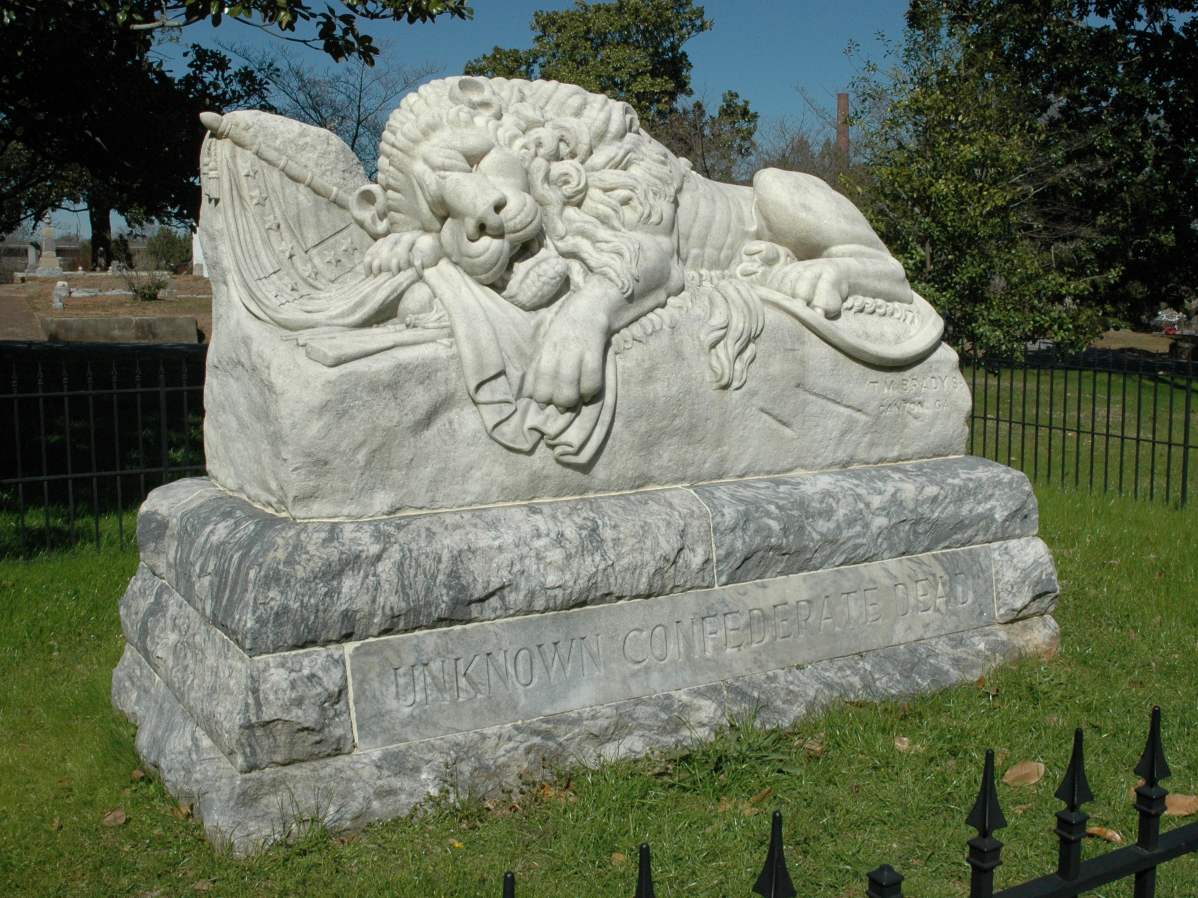
To truly appreciate the work of the Lion Monument, simply cast your eyes over the Lion of the Confederacy, a sculpture in Oakland Cemetery in Atlanta, Georgia.


The lion, which guards a field containing the remains of unknown Confederate and Union dead, was carved by T. M. Brady in 1894, and is a very near copy of (or at least, greatly inspired by) the Lion Monument from Lucerne. However, it has far less impact, despite being a monument to an equally tragic and powerful event. I feel that this is almost entirely due to the setting. The lion in Georgia is vulnerable and weak; it has been dragged out into the open to die alone in a field, surrounded by enemies and vultures. Compare it to the other Lion, which is at rest; although dying, he is safe and secure, having made his way to a favourite place in which to spend his final moments at peace. He may have been killed, but he is strong enough to die on his own terms, in the place that he chooses, knowing that he did his best. Perhaps Mark Twain summed it up better:

"The Lion lies in his lair in the perpendicular face of a low cliff — for he is carved from the living rock of the cliff. His size is colossal, his attitude is noble. His head is bowed, the broken spear is sticking in his shoulder, his protecting paw rests upon the lilies of France. Vines hang down the cliff and wave in the wind, and a clear stream trickles from above and empties into a pond at the base, and in the smooth surface of the pond the lion is mirrored, among the water-lilies.

Around about are green trees and grass. The place is a sheltered, reposeful woodland nook, remote from noise and stir and confusion — and all this is fitting, for lions do die in such places, and not on granite pedestals in public squares fenced with fancy iron railings. The Lion of Lucerne would be impressive anywhere, but nowhere so impressive as where he is."


Mark Twain, A Tramp Abroad, 1880